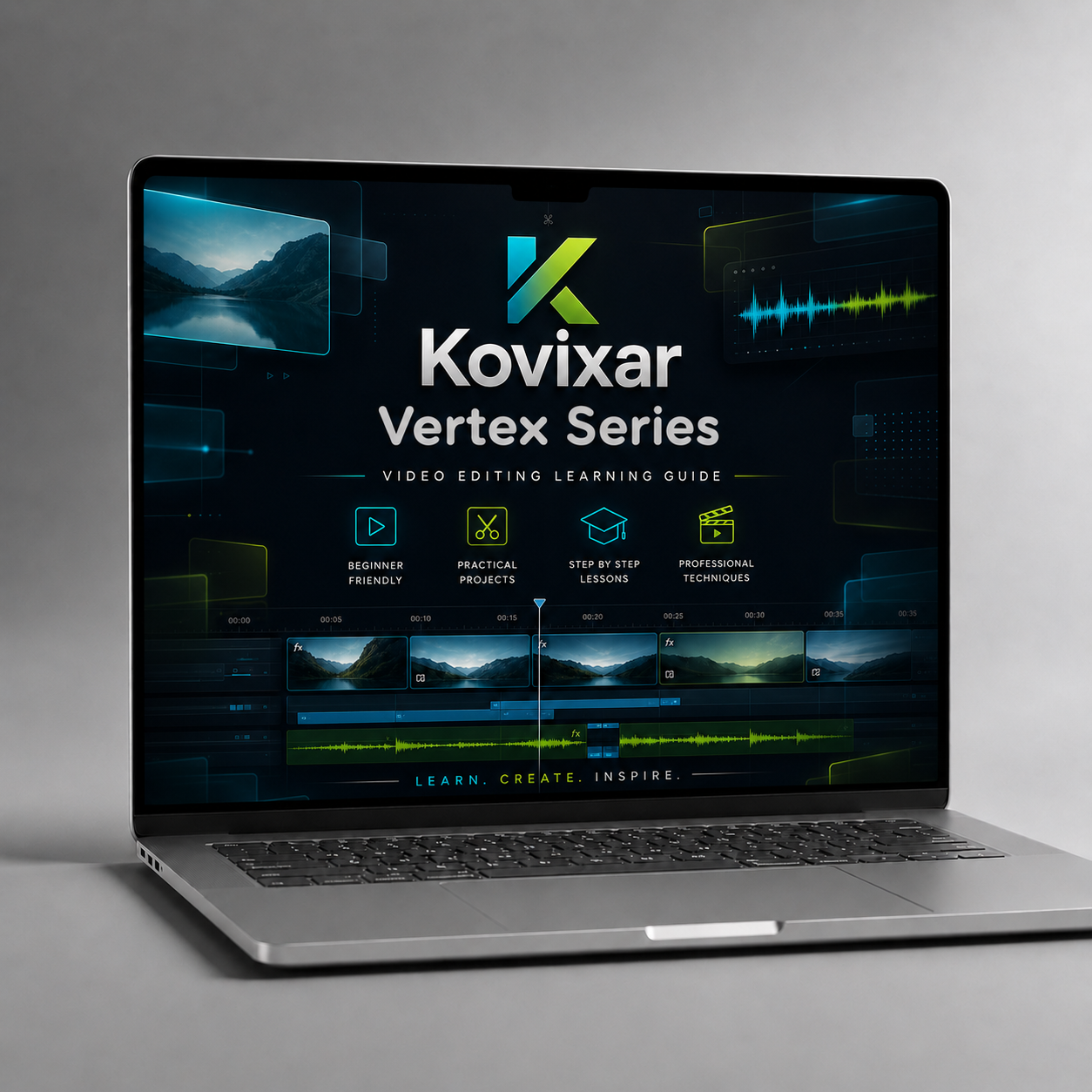
Kovixar
Vertex Series
Vertex Series
Couldn't load pickup availability
- ⬇️ Digital file available after purchase
- 🗂️ Long-term availability
- 🔒 Secure checkout
- 🗓️ Content updated in 2026
Self-paced learning overview
1. Problem Statement
When a person already understands the base of editing, the role of the frame, and the visual mood of a scene, the next challenge often appears while working with several materials at once. One fragment may feel gathered, yet the full series may lose unity because of uneven pacing, changing presentation, or inconsistent structure. Sometimes a creator edits separate scenes with care, but does not see how they should work together within one learning, creative, or showcase set. Because of that, the materials may feel as if they were made with different approaches, even when the topic is the same. Vertex Series is created to help users build editing series with more attention to rhythm, repeated choices, and general unity.
2. Solution
Vertex Series helps users move from separate editing decisions to series-based thinking. In this plan, users study how to connect several works through shared structure, pacing, opening logic, transitions, and endings. The materials explain how to create repeated editing rules for personal sets without mechanically copying every step. Users learn which elements should repeat for recognition and which may change depending on the topic, mood, or scene format. This approach helps users work with the course not as a group of disconnected modules, but as a consistent learning path.
3. What’s Inside
Vertex Series includes an expanded set of modules focused on building series logic in editing. If Luma Guide helped users look more carefully at the visual mood of a scene, Vertex Series shifts attention to a wider level: how several materials can share one language, pace, and inner order.
The first block introduces the idea of an editing vertex. In this plan, the vertex is treated as the point where rhythm, frame, structure, and mood meet. Users study how to define the main direction of a series: what should repeat, what presentation style should be maintained, and how to keep a general line between separate materials. This helps users look not only at one fragment, but at a full group of works.
The second block explores repeated structure. In a series, materials should not feel randomly assembled. The module explains how to build a similar order: opening part, scene development, main accent, soft transition, and ending. At the same time, the materials do not need to look identical. The purpose of this block is to show how to keep order while leaving room for different topics and moods.
The third block is focused on rhythm across a series. One material may have a calm pace, another may feel more dynamic, but they can still share one sense of style. In this block, users study how to work with scene length, transition frequency, pauses, and repeated accents. Special attention is given to avoiding sharp changes in pace when they do not support the idea.
The fourth block is about visual sequence. It continues the theme of Luma Guide, but across several materials. Users review how light, tone, contrast, and overall mood can work together within a series. The materials include examples where one set feels scattered because of an inconsistent visual approach, while another feels more gathered through attentive fragment placement.
The fifth block contains a module about personal inner rules. These are not rigid templates, but a set of personal choices that help keep style across a series. For example: how to begin a material, how to introduce the main frame, how to end a scene, how to work with pauses, and how to return to the key topic. Users learn to write down these rules and apply them during independent work.
The sixth block includes Vertex Review practical exercises. They are built around reviewing several materials at once. Users compare scenes, check whether they share a common rhythm, whether one fragment stands apart from the general mood, and whether structure repeats where it is useful. These exercises help develop attention not only to a frame, but also to a full set of works.
The seventh block contains working tables for series planning. Users can write down the topic of each material, main accent, approximate pace, visual mood, ending type, and editing notes. This helps keep decisions organized and lets users see the learning path in front of them.
Vertex Series also includes a selection of mini reviews. They show how a series can lose unity because of different openings, uneven pace, random transitions, or inconsistent visual style. Next to them, neutral editing options are shown to help make the materials more aligned.
4. Who is this for?
Vertex Series is for those who have already worked with separate scenes and want to think on a wider level. This plan suits users who create or plan to create several editing materials within one topic, selection, or learning path.
It also suits those who notice that separate scenes look good, but together they do not share one rhythm. Vertex Series helps users study how to keep unity across a series, how to repeat useful elements without monotony, and how to build personal rules for working with material.
5. What You’ll Learn
With Vertex Series, you can:
- understand how to build a series of editing materials;
- define a shared structure for several works;
- keep rhythm across a selected set;
- work with repeated elements without unnecessary monotony;
- review why separate scenes may not connect well;
- create personal working rules for editing series;
- compare several materials by pace, mood, and structure;
- notice which fragment stands apart from one shared line;
- plan the opening, development, and ending for each material;
- use tables to organize a learning path;
- connect frame, rhythm, light, and structure in a wider set;
- prepare for the next plan, where there is more attention to material libraries and learning organization.
6. 30-Day Terms
We want working with Vertex Series to feel clear and calm. If, after ordering the plan, the materials do not match your expectations, you can contact us within 30 days. The team will review your message according to the store terms and reply with a possible resolution. In your message, please include your name, email address, order date, and a short description of the situation.
Are the courses suitable for beginners in video editing?
Are the courses suitable for beginners in video editing?
Yes, the materials are built to gradually introduce editing logic, frame rhythm, scene structure, and basic ways of working with footage.
What is included in Kovixar plans?
What is included in Kovixar plans?
Depending on the plan, you receive learning modules, written explanations, practical tasks, review examples, curated materials, and extra resources for independent study.
Do I need previous editing experience?
Do I need previous editing experience?
No, some plans are made for starting with basic topics, while higher plans gradually add more structure, practice, and deeper reviews.
Share